
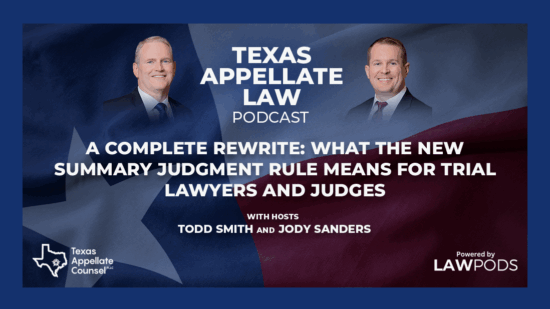
The Texas Supreme Court is taking comments on its rewritten summary judgment Rule 166a before the rule goes into effect on March 1. To help practitioners understand its implications, hosts Jody Sanders and Todd Smith provide context for the rewrite and take a deep dive into the rule’s requirements. Tune in as they break down, among other details, how the rule defines traditional and no-evidence summary judgments, what it requires when those motions are combined, and how it changes the timing of the non-movant’s response to within 21 days after the motion is filed.
As Jody explains, the Court concluded that summary judgment motions “were either sitting around too long without being heard or without being ruled upon” and set out to address that problem. Todd adds, “This is a huge change from the old rule” that will “require non-movants to be far more proactive in getting their responses done and ready than they were before.
References:
Giana Ortiz & Jacob Fain, SB 293 and HB 16: A Faster Track for Summary Judgments, Advocate 18 (Vol. 113, Winter 2025) (State Bar of Texas Litigation Section).
Hon. Jerry Bullard, Legislative Update (State Bar of Texas Appellate Section CLE, Oct. 31, 2025).
Email your comments about Rule 166a to rulescomments@txcourts.gov by February 28.
Listen to or watch the episode through the players below.
Connect and Learn More
☑️ Todd Smith | LinkedIn | X | Bluesky
☑️ Jody Sanders | LinkedIn | X | Bluesky
☑️ Texas Appellate Law Podcast on LinkedIn | X | Instagram | Bluesky
☑️ Texas Appellate Counsel PLLC
☑️ Kelly Hart & Hallman, LLP | LinkedIn
☑️ Subscribe Apple Podcasts | Spotify | Amazon Music | YouTube
Produced and Powered by LawPods.
Sponsored by Court Surety Bond Agency and Proceed (formerly Counsel Press).

Help others discover the podcast.
If the show has helped you, please subscribe, share, or consider leaving a 5-star review to help others find it too.
Need help? Here’s a quick guide.